
What Are the Key Differences Between Dayal’s PU (Polyurethane) vs. Acrylic Sports Flooring for Multi-Sport Use?
When someone reaches out to Dayal Sports about flooring a new multi-sport facility, one question comes up almost every single time: Should we go with PU or acrylic? It’s a genuinely important question, and the honest answer is that it depends on where you’re building and what you need the surface to do.
Both are serious, proven flooring systems. Both are part of Dayal’s sports infrastructure offering. But they are built differently, perform differently, and suit different environments. Understanding those differences before you commit is the kind of decision that saves you a lot of money and frustration over the next decade.
What Each Flooring System Actually Is
Dayal’s acrylic sports flooring is a patented hard acrylic paving material. The main resin is composed of high-hardness, dye-resistant Acrylate Emulsion polymer combined with hydrophobic nano-silica fibres, pigments, fillers, and other additives. It is mixed with cement and quartz and applied by scraping or spraying over new or existing cement or asphalt foundations. The result is a firm, textured, multi-layer surface that bonds tightly to the base and provides consistent grip across a wide area.
Dayal’s PU flooring, on the other hand, is described as an environmentally friendly silicone-modified polyurethane material, a unique silicone-modified polyurethane plastic with low surface energy, good weather resistance, wear resistance, hydrolysis resistance, and water permeability. Unlike acrylic, which is a surface coating system, PU flooring is an elastic, seamless, poured system that creates a cushioned, joint-free surface from below, not just on top.
The Outdoor vs. Indoor Question
This is the most fundamental split between the two systems, and Dayal’s own product range reflects it clearly.
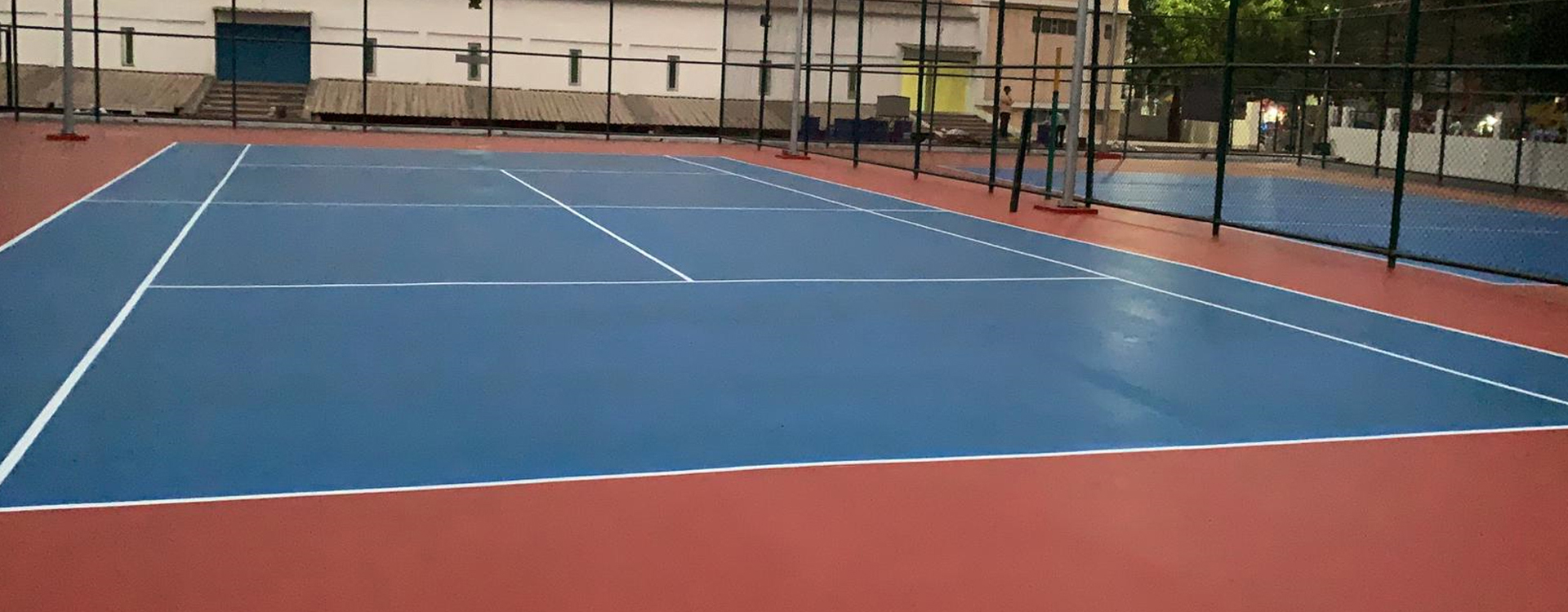
Acrylic is Dayal’s outdoor flooring solution. The composition is deliberately built for UV resistance from the Acrylate Emulsion polymer, crack resistance from the quartz and cement mix, and anti-skid texture from the silica fibres in the topcoat. Indian conditions, scorching summer heat, heavy monsoon rain, and coastal humidity are genuinely hard on outdoor surfaces, and acrylic is engineered to handle all of that without fading, cracking, or losing its grip characteristics. For outdoor multi-sport courts covering badminton, basketball, tennis, or any combination, acrylic is the practical and proven choice. Dayal’s acrylic sports flooring service is priced starting from around ₹78 per sq ft, making it one of the most cost-effective performance surfaces available for outdoor facilities across India.
PU flooring earns its place indoors. Polyurethane sports flooring is mainly used for indoor basketball and badminton, where it is applied as a liquid to create a seamless, elastic, joint-free surface that is easier on players’ bodies. Its silicone-modified construction gives it excellent hydrolysis resistance and wear performance in controlled environments, but prolonged UV exposure outdoors causes yellowing and softening over time, which is why Dayal deploys PU specifically for indoor sports venues and premium multi-sport halls rather than open-air facilities.
Comfort and Athlete Safety: Where PU Pulls Ahead
If you’re building a facility where players train for multiple hours a day, an academy, a sports club, or a competitive indoor hall, the flooring’s impact on the body matters enormously. This is where PU flooring has a clear functional advantage.
Dayal’s PU sports flooring is engineered specifically around this problem. As they describe it, their 5-layer sports flooring system is suitable for high-performance venues and has three basic functions: motor, protective, and technological. They explain it directly: great pressure is on the feet, ankles, and lower back during training and competition. If athletes exercise on a surface with no suspension or inadequate suspension, they will get hurt. Dayal’s professional 5-layer suspension sports flooring system is designed with excellent damping performance and a safe frictional coefficient specifically to avoid such injuries.
Acrylic sports flooring does not absorb shocks as well, which can be harsh on joints during high-impact sports. For recreational courts, school facilities, or outdoor settings, that trade-off is acceptable. But for a serious training environment where players are on court every day, the joint protection that PU provides is not a luxury; it’s a genuine health investment.
Which One Is Right for Your Facility?
If you’re building an outdoor multi-sport court for a school, a residential society, a community sports park, or an open-air academy space, Dayal’s acrylic flooring is the right call. It handles Indian weather, it’s cost-effective at scale, it’s low maintenance, and it delivers a consistent, safe playing surface for badminton, basketball, tennis, and other racket and court sports.
If you’re building a premium indoor training hall, a sports academy with year-round intensive use, or a multi-sport complex where players train seriously at high intensity for hours every day, Dayal’s PU flooring is the better investment. The joint protection, the seamless durability, and the high-performance playing characteristics justify the additional upfront cost when the usage intensity demands it.
Dayal Sports has built its reputation on delivering Olympic and international standard sports infrastructure across Asia. Whether you need the outdoor resilience of acrylic or the indoor performance depth of PU, the expertise behind both systems comes from the same place: a team that has tested these surfaces in real Indian conditions and holds international quality accreditations to prove it.