
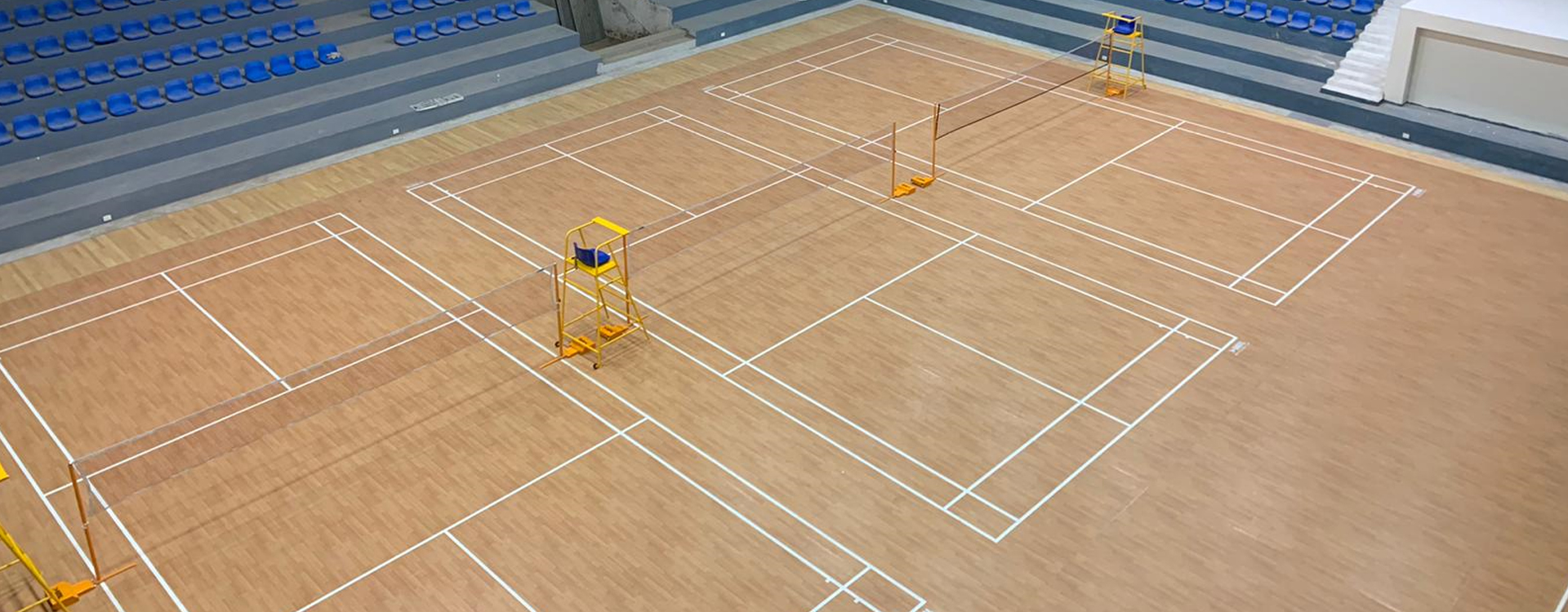
How Does Dayal’s Suspended Air-Cushioned Flooring Technology Reduce Long-Term Knee Injuries in Athletes?
If you have ever played badminton on a concrete floor or a cheap tiled court, you know that feeling after two hours of play: a dull ache in the knees, heavy legs, and joints that remind you exactly how many times you lunged, jumped, and pivoted during the session. That soreness is not just tiredness. It is your body’s response to impact forces that the floor failed to absorb. Over weeks and months, those unabsorbed forces accumulate. And for serious athletes who train daily, that accumulation turns into chronic knee pain, cartilage wear, and injuries that shorten careers.
This is precisely the problem that Dayal Sports’ Suspended Air-Cushioned flooring technology is designed to solve. At Dayal Sports, founded by Dr. Yuva Dayalan, a former International Badminton Player who understands joint stress from the inside of a court, not just a boardroom, the philosophy behind every flooring system is built around one question: Does this protect the athlete first?
The Science of What Happens to Your Knees on a Hard Court
To understand why the flooring beneath your feet matters so much, it helps to understand what actually happens during a typical badminton rally. A player performing a jump smash lands with a force that can be three to five times their body weight, concentrated on a fraction of a second of ground contact. A quick split-step, a deep lunge to the net, a sudden change of direction, each of these movements generates impact forces that travel upward through the foot, ankle, knee, and hip.
On a hard, unforgiving surface like concrete or solid tile, that energy has nowhere to go except back into the body. The knees, as the largest and most mechanically complex joints in the lower body, take the worst of it. The patellar tendon, the meniscus, and the knee cartilage are subjected to repeated microtraumas, small-scale damage that individually heals but collectively degrades joint health over time. Orthopaedic specialists identify this as a primary cause of “jumper’s knee” (patellar tendonitis), meniscal tears, and early-onset knee arthritis in court sports athletes.
The solution is not just better footwear, though that matters too. The floor itself must be engineered to do a significant share of the shock absorption work before the force even reaches the athlete’s body.
What “Suspended Air-Cushioned” Actually Means
The term sounds technical, but the principle is elegant. Dayal’s suspended floor systems, including the flagship 7-layer suspension maple wooden flooring and the 5-layer maple wood suspension flooring available through Dayal Sports, are not simply wooden planks laid on a concrete base. They are multi-layer structural systems where the playing surface is mechanically suspended above the subfloor through a series of engineered layers, with air gaps and cushioning elements built into the construction.
Think of it the way a car’s suspension system works. The wheel hits a pothole, but the chassis above barely feels it because the suspension has absorbed and redistributed the energy. In a suspended floor, the player’s foot strike hits the maple surface, but instead of that force passing straight into the concrete, it travels down through the layer system, which compresses, flexes slightly, and dissipates a significant portion of the energy before anything reaches the subfloor.
The air pockets and cushioning elements within the suspension layer act as controlled shock absorbers. They compress under load and spring back as the player’s foot lifts, providing a slight, controlled give to the surface that a rigid floor cannot offer. This is what creates that distinctive “live floor” feel that professional athletes describe: a surface that works with your body rather than against it.
How Each Layer of Dayal’s System Contributes to Joint Protection
In Dayal’s 7-layer suspension maple wooden flooring, every layer has a specific role in the injury-prevention chain. The bottom layer sits on the subfloor and anchors the system. Above it, pine wood runners form the structural frame that creates the elevated suspension. The space between the runners is where air circulation happens, and it is this spacing that gives the floor its characteristic resilience. Rubber shock pads are positioned at key structural points, absorbing vertical impact energy at the source before it can travel upward. The intermediate layers add structural integrity while maintaining the elasticity of the system as a whole. At the top, the maple surface boards finished with BONA DIN-approved polyurethane lacquer deliver the playing surface itself, with the anti-slip finish providing the grip that prevents the knee-twisting slips that cause acute ligament injuries.
The combined effect is a floor that absorbs a meaningful percentage of each impact force rather than reflecting it back into the athlete’s joints. The sub-floor and cushioning layers work together to reduce the stress on athletes’ joints, especially the knees, ankles, and hips, and by minimizing the impact on these joints, the risk of injuries such as sprains, strains, and joint damage is significantly decreased, allowing athletes to perform at their best for longer periods without fear of excessive wear and tear.
Why Maple Wood Is the Right Material for This System
Not all wood behaves the same way in a sports floor. Maple is specifically chosen for professional badminton courts worldwide for a combination of reasons that directly support athlete safety.
Maple is the hardest of the commercially used hardwoods for sports flooring. Its density gives it the rigidity needed to maintain surface uniformity, preventing the uneven spots and soft zones that create unpredictable underfoot conditions. At the same time, it has a natural elasticity that allows it to flex microscopically under load without cracking or warping. Maple wood is known for its durability, strength, and shock absorption properties, and it is the recommended wood for badminton courts. This combination of hardness and slight natural flex makes it the ideal top layer for a suspension system, because it distributes impact horizontally across the surface before the force even reaches the cushioning layers below.
Dayal sources kiln-dried maple that is treated with anti-termite and moisture-resistant coatings from the production stage. In India’s climate with high humidity, monsoon moisture, and temperature extremes, a floor that warps, swells, or develops uneven sections is not just a maintenance problem; it is an injury risk. A perfectly flat, consistent surface is as important for injury prevention as the shock absorption layers beneath it.
What This Means for Academies, Schools, and Commercial Courts
The practical implication of all this technology is straightforward. Athletes who train on Dayal suspended air-cushioned courts over long periods experience less joint fatigue during sessions, recover faster between training days, and are significantly less likely to develop the chronic knee conditions that cut short promising careers. Coaches at training academies report that players can sustain higher-intensity training loads over longer periods without the physical breakdown that comes from hard-floor training environments.
For academy owners and sports facility managers, a wooden suspended floor is not just a premium feature; it is a player welfare investment. Parents enrolling children in academies, professional coaches managing athlete workloads, and sports organizations responsible for player welfare all have a strong rationale for insisting on a suspended floor system that genuinely protects joints over the long term.
Dayal Sports supplies and installs these flooring systems across India and Asia, working with schools, professional academies, government sports institutions, and commercial sports complexes. Whether you are setting up a new facility or upgrading an existing court, the team at Dayal Sports provides a complete service from site survey through installation to post-installation maintenance guidance.