Why Modular Sports Flooring Is Growing in Indian Sports Infrastructure
A few years ago, walk into a school sports hall or a local badminton academy in India, and you would likely find plain cement or cracked outdoor concrete. Today, that picture looks very different.
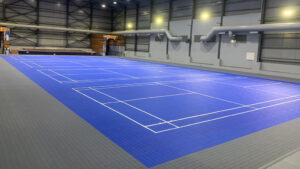
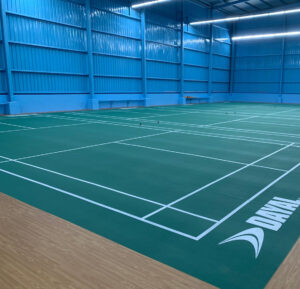
Walk into any new sports facility, and you will probably find a brightly coloured, interlocking modular court that went up in a matter of days and is already being used for three different sports. Asia-Pacific is now the fastest-growing sports flooring market globally, and India is right at the centre of that growth. Modular sports flooring is leading the way.
What Is Modular Flooring?
Modular sports flooring is a surface made of individual tiles that lock together like puzzle pieces. No glue. No complicated construction. No waiting weeks for curing or drying.
The most common type in India right now is PP interlocking flooring made from virgin polypropylene, a food-grade, non-toxic, and recyclable material. You place them on any flat surface, snap them together, and the court is ready. That simplicity is a big part of why modular flooring is growing so fast across India.
The Khelo India Effect
The Indian government’s Khelo India programme has pushed sports infrastructure from an afterthought to a national priority. Financial assistance is being provided to states and Union Territories to develop sports facilities, with dedicated sports schools and academies being set up across the country to nurture young talent.
That government push has unlocked private investment, too. With rapid growth in academies, gyms, residential sports areas, and professional arenas, high-quality sports flooring is now a necessity and not a luxury. Modular flooring fits this boom perfectly. Dayal Sports supports India’s growing sports infrastructure with certified flooring systems built for exactly this demand.
Schools Choose Modular First
Traditional permanent flooring, such as acrylic, PU, or wooden surfaces, can take weeks from base preparation to a playable surface. Modular tiles go from delivery to playable in a single day. For a school that needs a functioning court before the new academic year, that speed is essential.
The fast-install modular surfaces from Dayal Sports mean students are playing from day one, not waiting weeks for a permanent surface to cure.
One Surface for Every Sport
Multi-purpose courts can accommodate basketball, tennis, volleyball, and badminton in a single layout, saving space and increasing usability. Modular tiles make this easy. The same surface that hosts badminton on Monday can be reconfigured for basketball by Thursday, with different court lines marked in different colours.
You are not buying a badminton floor. You are buying a multi-sport platform that adapts to whatever the programme needs, making it one of the most practical investments a school or academy can make.
The Budget Advantage
A PP modular court costs approximately Rs. 5 to 7 lakhs, a fraction of what a full wooden or PU installation requires. But it is not just the upfront cost. Modular tiles need no specialist cleaning, no resurfacing cycles, and no professional maintenance visits. If a tile gets damaged, you replace that one tile, not the entire court.
For growing academies working with limited capital, this keeps quality high and costs predictable. Get a quote tailored to your facility from the Dayal Sports team.
Built for Indian Weather
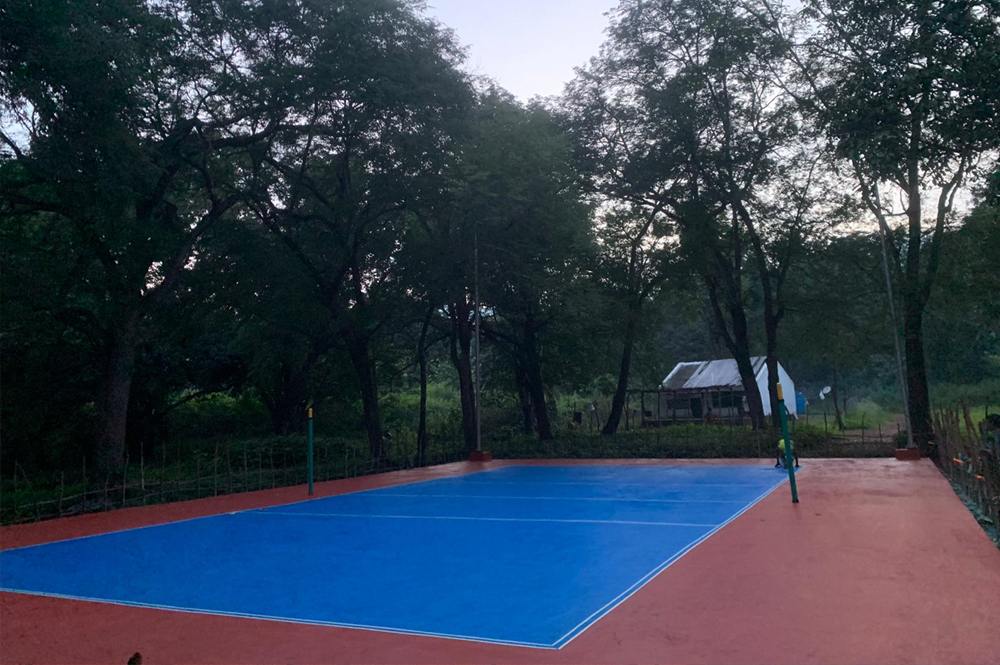
PP interlocking tiles are UV-resistant, waterproof, and handle temperatures from -40 degrees C to 80 degrees C without warping, cracking, or losing grip. The open-grid structure allows rainwater to drain through rather than pooling on the surface, so outdoor courts stay playable shortly after rainfall.
For a country where sports programmes battle monsoon seasons and scorching summers, that weather resilience is a major advantage over surfaces that need covered, climate-controlled environments to survive. Dayal’s outdoor-ready modular courts are built for India’s most demanding conditions.
Courts Are Appearing Everywhere
PP modular tiles are being installed in housing societies, rooftop terraces, covered parking areas, and indoor corridors across urban India. Spaces that would never have been considered suitable for a sports surface before are now hosting functional courts.
Modular flooring makes this possible because it does not require a purpose-built foundation. Any flat, dry surface can become a court. That is opening up sports to communities and spaces that traditional flooring would never reach.
Eco-Friendly by Design
Dayal Sports’ modular flooring products are made with at least 30% recycled materials, are made with zero virgin polyester, and carry environmental certifications alongside performance certifications. The tiles are fully recyclable at the end of life, which matters for institutions with sustainability commitments.
For schools, universities, and government facilities that need to demonstrate responsible procurement, that sustainability profile adds real value beyond sports performance alone.
Why Dayal Sports?
Dayal Sports was founded by Dr. Yuva Dayalan, a former International Badminton Player and Yoga Champion, with one goal: to give every athlete a world-class surface regardless of the size or budget of their facility.
Dayal’s modular PP interlocking flooring is made from food-grade non-toxic virgin polypropylene, is anti-slip and shock-absorbing, UV-resistant, suitable for badminton, basketball, volleyball, futsal, and table tennis, and backed by professional performance testing for friction, shock absorption, and safety. Whether you are setting up a court for a school sports day or a growing academy, Dayal Sports has the product and expertise to make it happen right.
Quick Questions Answered
Q: Is modular flooring good enough for competitive play?
Yes. For school, academy, and club-level competition, Dayal Sports’ PP interlocking tiles deliver the right combination of grip, shock absorption, and surface consistency. For the highest level of BWF or FIBA-sanctioned international competition, permanent wooden or PVC Hova surfaces are the preferred standard.
Q: How long does modular PP flooring last?
With regular cleaning and prompt replacement of any damaged tiles, good quality PP interlocking flooring has a service life of 8 to 12 years. Individual tiles can be replaced without disturbing the rest of the court, keeping the surface safe and consistent throughout its life.
Q: Can modular flooring be moved and reinstalled elsewhere?
Yes. The tiles can be disassembled, transported, and reinstalled at a new location without any loss of performance. For academies that are growing and relocating, or event organisers who move between venues, this portability makes modular flooring a genuinely flexible long-term investment.
For more product details, visit our complete modular flooring range at dayalssports.com
For enquiries and contact details, visit dayalssports.in