
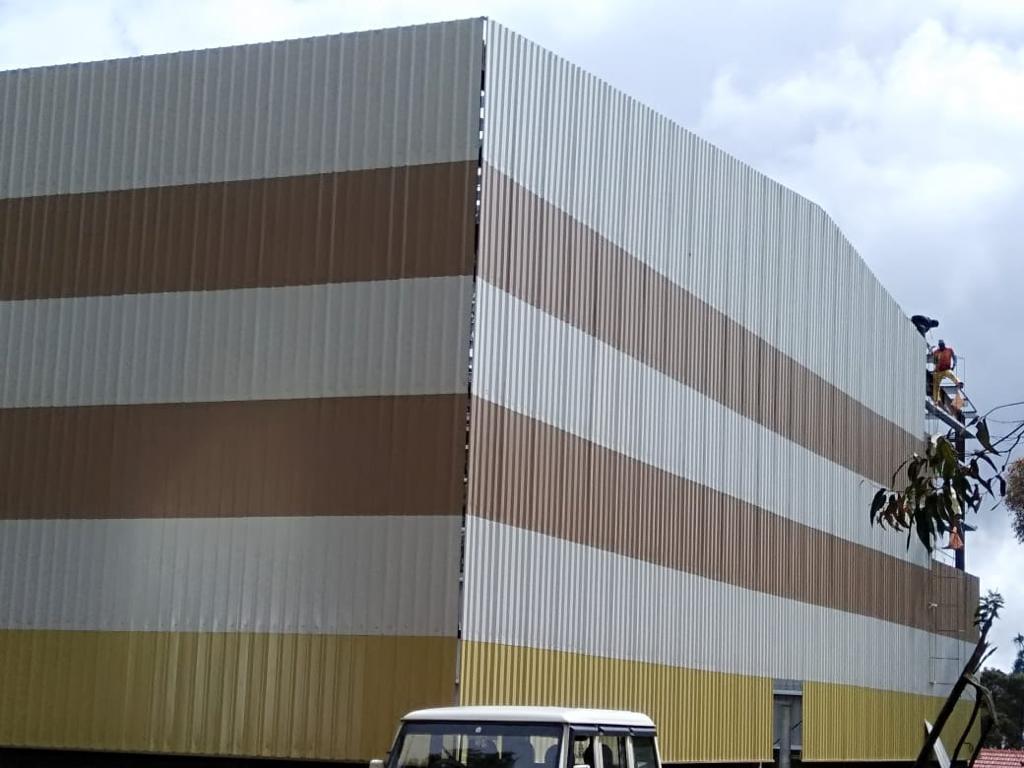
PEB Structures vs Conventional Construction for Sports Complexes
How would you feel if you were in a sports hall with a huge, column-free space featuring four badminton courts side by side, perfect lighting, a temperature of 17 degrees, and the best quality floor for a national tournament? Now imagine that all of this is being built in half the time and at half the cost of a conventional concrete structure. This is what modern Indian sports facilities are achieving across the country with Pre-Engineered Building (PEB) technology. At Dayal Sports, we work with academies, schools, and sports organizations at every stage of facility development, whether it’s the structure or the surface.
What Does PEB Structure Mean?
A Pre-Engineered Building (PEB) is a steel building consisting of assembled, factory-fabricated, and erected components such as girders, columns, and frames. Instead of constructing the entire building on site, most of the work is completed in factories under specifically controlled environments before being transported to the site for assembly.
In contrast, traditional construction uses reinforced cement concrete (RCC), which is built on-site by hand from bricks, steel, cement, and concrete.
Where PEB Wins
- It Goes Up Much Faster
PEB structures reduce construction time by 30 to 50 percent compared to conventional RCC buildings. Factory fabrication and site preparation happen at the same time, which cuts out the waiting periods that slow down traditional construction. For a school or academy that wants to open before a new academic year or sports season, this speed is a genuine advantage.
- It Costs Less to Build
PEB structures help save 25 to 40 percent on construction costs by reducing material wastage, shortening timelines, and lowering labour and financing expenses. Computer-aided design ensures optimal material usage, eliminating the wastage that plagues traditional construction sites. The steel framework also distributes load more efficiently, which means lighter foundations and less excavation compared to RCC structures.
- The Clear Span Advantage
This is the most important factor for sports facilities specifically. PEB structures can deliver clear spans of 30 metres or more without internal columns. For a badminton hall, basketball court, or multi-sport complex, that column-free interior is essential. Conventional RCC construction struggles to achieve the same wide spans without significantly higher cost and complexity.
- Strong Against the Elements
PEBs are built using high-grade steel that is lightweight yet strong and resistant to extreme weather conditions, earthquakes, and corrosion. For sports halls in coastal regions or areas with significant seismic activity, this structural resilience is a meaningful advantage over traditional construction.
- Expand It Later Without Major Work
PEB offers versatile and modular designs, accommodating future expansions and custom requirements with ease. Conventional construction requires significant structural adjustments for changes, which can be costly and time-consuming. For an academy that starts with two courts and plans to grow to four, PEB makes that expansion far simpler.
Explore how Dayal Sports delivers complete sports facility infrastructure, including flooring, lighting, and court systems designed to work within PEB structures.
Where Conventional Construction Wins
- Design Complexity and Aesthetics
The conventional RCC construction allows more flexibility for special architectural elements, non-conventional shapes, and interior finishes. If the sports complex is within an institutional building with particular design specifications, the conventional methods may be more compatible with the entire structure.
- Proven for Multi-Storey Buildings
For sports complexes with upper decks, parking buildings, change houses and office blocks, laid out as multiple-storey RCC is the most commonly used and accepted method in India. PEB is the better choice for single to low-rise buildings with large spans.
- Local Familiarity
Conventional is already well known to most contractors local to the parts of India that have large numbers of conventional construction; if it is difficult to obtain PEB specialists, then conventional may be more suitable for smaller projects and those with limited access to experienced PEB erectors.
Head-to-Head Comparison
Here is a simple side-by-side look at how the two methods compare for sports complex construction:
- Construction speed: PEB is 30 to 50 percent faster than conventional RCC.
- Cost: A PEB system results in a 25 to 40 percent savings on the total construction cost
- Clear span: It is very easy for PEB to attain wide clear spans without Columns. To get the same clear span in RCC, vast engineering is required.
- Weather resistance: PEB steel performs better than heavy RCC to resist wind and seismic forces in most situations
- Future developments: PEB is easy to extend; RCC needs major structural expansion
- Aesthetic flexibility: Traditional RCC has more complex aesthetic choices
- Multi-storey suitability: RCC is more suitable for multi-storey structures.
- Availability of local contractors: RCC is comparatively well-known across a broad spectrum of areas.
Choose PEB If You Need These
- A large, zero-column high sports hall for badminton, basketball, volleyball, or multi-sport usage
- Wrap up as quickly as possible in order to open to the public before a specific season or deadline, so as to maximize the popularity of the development at opening time.
- Lower initial construction cost and potential for future upgrades.
- A building in a seismic or coastal zone where building resilience is a concern
Choose Conventional If You Need These
- A building with interior space on several floors, including offices, changing rooms, and sports courts.
- Complex architectural design or specific aesthetic needs
- A project in an area where there are no experienced PEB subcontractors
- A less extensive sports store for our studio that avoids broad open spans.
Why Choose Dayal Sports for Your Facility
Dayal Sports was founded by Dr. Yuva Dayalan, a former International Badminton Player and Yoga Champion. We bring together research and development, design, production, construction, and installation under one roof so that every part of your sports complex is planned and delivered with the same level of care and precision.
We supply and install sports flooring across India and Asia, with a track record of projects in schools, professional academies, municipal stadiums, and community sports centres. Whether you are starting from the foundation or finishing an existing structure, our team helps you choose the right surface, specify it correctly for your usage pattern, and install it to the standard that athletes deserve.
For more product details, visit dayalssports.in
For enquiries and contact details, visit dayalssports.com