
How Does Indian Sports Flooring Compare to International Standards in Terms of Shock Absorption and Player Safety?
If you’ve ever trained on a badminton court that made your knees ache after a long session, or played on a surface that felt too hard underfoot with every landing, you already know how much the floor matters. It’s not just about looks or court lines. The surface beneath your feet determines how safely you can train, how quickly your body recovers, and ultimately how long your playing career lasts.
The honest conversation about sports flooring in India is this: the gap between what’s commonly installed and what international standards actually demand is wider than most facility owners and players realize, but that gap is closing, and it’s closing because brands like Dayal Sports are bringing genuinely international-grade flooring solutions to courts across the country.
What International Standards Actually Demand
Globally, professional sports flooring, especially for badminton, basketball, and volleyball, is evaluated against standards like the German DIN norms and certifications from bodies like BWF (Badminton World Federation) and FIBA. These frameworks set clear, measurable requirements for shock absorption, ball rebound, slip resistance, and surface deformation. The core principle is simple: when an athlete lands, falls, or changes direction at speed, the floor must absorb a significant portion of that impact before it reaches the player’s joints.
Specifically, international standards require that over 53% of the impulse generated when an athlete contacts the floor must be absorbed by the surface itself. This protects the ankles, knees, meniscus, spine, and even the brain from the repeated stress of training and competition. A floor that fails this threshold might look fine and feel firm, but it quietly accumulates damage in the body, exactly the kind of injury that sidelines players gradually rather than suddenly.
Where Indian Facilities Often Fall Short
Traditionally, many sports courts in India, particularly at school, club, and community levels, have been laid with concrete, plain hardwood, or low-grade synthetic surfaces that prioritize cost and durability over player safety. These surfaces are rigid, unforgiving, and offer little to no proper shock absorption. Players on these courts carry more physical load per session, recover more slowly, and face a higher long-term injury risk.
This isn’t unique to India; it’s a challenge across developing sports markets globally. But as badminton, basketball, and other indoor sports grow rapidly in India, the demand for internationally compliant flooring is rising just as fast.
How Dayal Sports Bridges the Gap
Dayal Sports approaches sports flooring the way it approaches every product by meeting players where they actually are, without compromising on the standards that keep them safe.
Their Grade A Maple Wooden Court system is a strong example. Built on a 5-layer or 7-layer suspension structure, it uses 22mm thick maple or oak surface boards, EPDM moisture-proof and shock-absorbing underlayers, 10-15mm elastic rubber pads, and pine keel framing, all engineered to meet the shock absorption and deformation requirements described in German DIN standards. The surface coating is done with environment-friendly, water-based Bona paint, which itself carries BWF and FIBA approvals. This is not a product approximating international quality; it is internationally certified flooring installed across India.
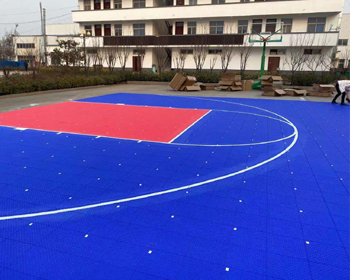
For facilities that need a high-performance surface at a more accessible investment, Dayal’s PVC Hova Court flooring delivers shock absorption, ball rebound, and slip resistance with ISO9001-2000 and ISO14001 certifications. It covers sports from badminton and basketball to futsal and volleyball, making it one of the most versatile compliant flooring options in the Indian market.
Dayal Sports’ founder, Dr. Yuva Dayalan, a former International Badminton Player, has developed over a dozen floor patents that have passed international and Olympic standard quality tests. That background means the engineering decisions behind every Dayal flooring system are made by someone who understands what a surface feels like under real playing conditions, not just in a laboratory.
The Player Safety Argument Is Simple
A safer floor is not a luxury; it is a long-term investment in every athlete who trains on it. Repeated impact on non-compliant surfaces leads to overuse injuries in the feet, ankles, knees, and lower back. These injuries are quiet until they aren’t, and they are largely preventable with the right surface underfoot.
As India continues to produce world-class badminton talent and expand its sporting infrastructure, the quality of the courts on which those athletes train will shape outcomes as much as the training itself. International-standard flooring is now accessible in India, not just for stadiums, but for academies, school halls, and club courts too.
To explore Dayal Sports’ full range of sports flooring solutions, including wooden courts, PVC Hova courts, PU flooring, and more, visit Dayal Sports and speak to the team about what’s right for your facility.