
Why Choose Dayal Infra for Pre-Engineered Building (PEB) Sports Halls Versus Traditional Civil Construction?
Building a new indoor sports hall is one of the largest capital decisions a sports authority, municipality, institution, or private academy can make. And increasingly, the conversation about how to build it is as important as the conversation about where to build it. Pre-Engineered Buildings, the structural steel systems that go up in a fraction of the time and at a more controlled cost than conventional reinforced concrete construction, have become the standard choice for indoor sports facilities globally. In India, that shift is happening faster than most facility planners expect.
Dayal Infra, operating through Yuva Horizon Wings and Dharunan World, has completed more than 100,000 square feet of PEB structures for sports facilities across the country, and the reasons behind that adoption tell a straightforward story about why PEB consistently wins the comparison against traditional civil construction for sports halls specifically.
Speed of Construction: The Argument That Changes Everything
Traditional civil construction for a multi-court indoor badminton hall involving foundation work, column casting, brick masonry, concrete roof structure, waterproofing, and finishing typically takes 12 to 24 months from site preparation to handover, depending on hall size, location, and contractor capacity. During that entire period, the facility is not generating any return, athletes don’t have access to training space, and institutional timelines slip.
A PEB sports hall structure of equivalent size, using factory-fabricated steel components assembled on site, typically achieves structural completion in 3 to 5 months. The components are manufactured in a controlled factory environment to engineered tolerances, then transported to the site and erected by specialist teams with the necessary equipment. Dayal’s infrastructure team operates skilled technicians handling JCB, cranes, bulldozers, and advanced high-end imported machinery, the kind of heavy equipment deployment that keeps steel erection timelines on schedule regardless of site conditions.
For a government sports authority working to an annual budget cycle, a municipality trying to meet a commissioning deadline for a district-level tournament, or an academy that needs courts operational before the next intake of students, this timeline difference is not just a convenience, it’s the factor that determines whether the project happens at all within the planned financial year.
Cost Certainty: Why PEB Changes the Budget Conversation
Traditional civil construction in India is notoriously susceptible to cost overruns. Variable material prices, weather delays, labour availability, and on-site design modifications are all standard contributors to budgets that expand well beyond initial estimates. For sports halls that require large column-free internal spans to accommodate courts, significant roof height, and specialized ventilation, the structural demands add further complexity and cost variability to conventional concrete construction.
PEB structures address this through factory-based fabrication. The steel framework is engineered precisely for the building’s specified dimensions, loads, and spans with all components manufactured off-site, priced before construction begins, and assembled from a defined bill of materials. Cost certainty is dramatically higher than in conventional civil projects because the major structural cost is determined at the design stage rather than accumulated through on-site conditions.
Dayal Infra’s team includes experienced and senior Architects, PEB Designers, and Structural Engineers, the specific disciplines required to design a PEB sports hall that meets both the technical requirements of the sports it houses and the structural requirements of the Indian climate and seismic zone. This in-house design capability means that the gap between what a client requests and what gets engineered is managed by people who understand both sports facility requirements and structural performance, rather than being outsourced to a general contractor who may not understand the column-free span requirements of a badminton or basketball hall.
Sports-Specific Structural Advantages of PEB
Traditional reinforced concrete construction creates its span by increasing beam depth and column density, both of which conflict directly with sports hall requirements. A column inside a multi-court hall is a safety hazard and a boundary violation. A beam that drops into the head height zone is an immediate disqualification for competition use.
PEB portal frame systems achieve the column-free internal spans that sports halls demand through the inherent efficiency of engineered steel. Long spans without interior columns are the core structural capability of the system, not an expensive special feature. For a 6-court indoor badminton hall, an 8-court facility, or a combined multiplex, the column-free span achieved by PEB is the natural solution.
The Integrated Advantage: Structure Plus Flooring Under One Roof
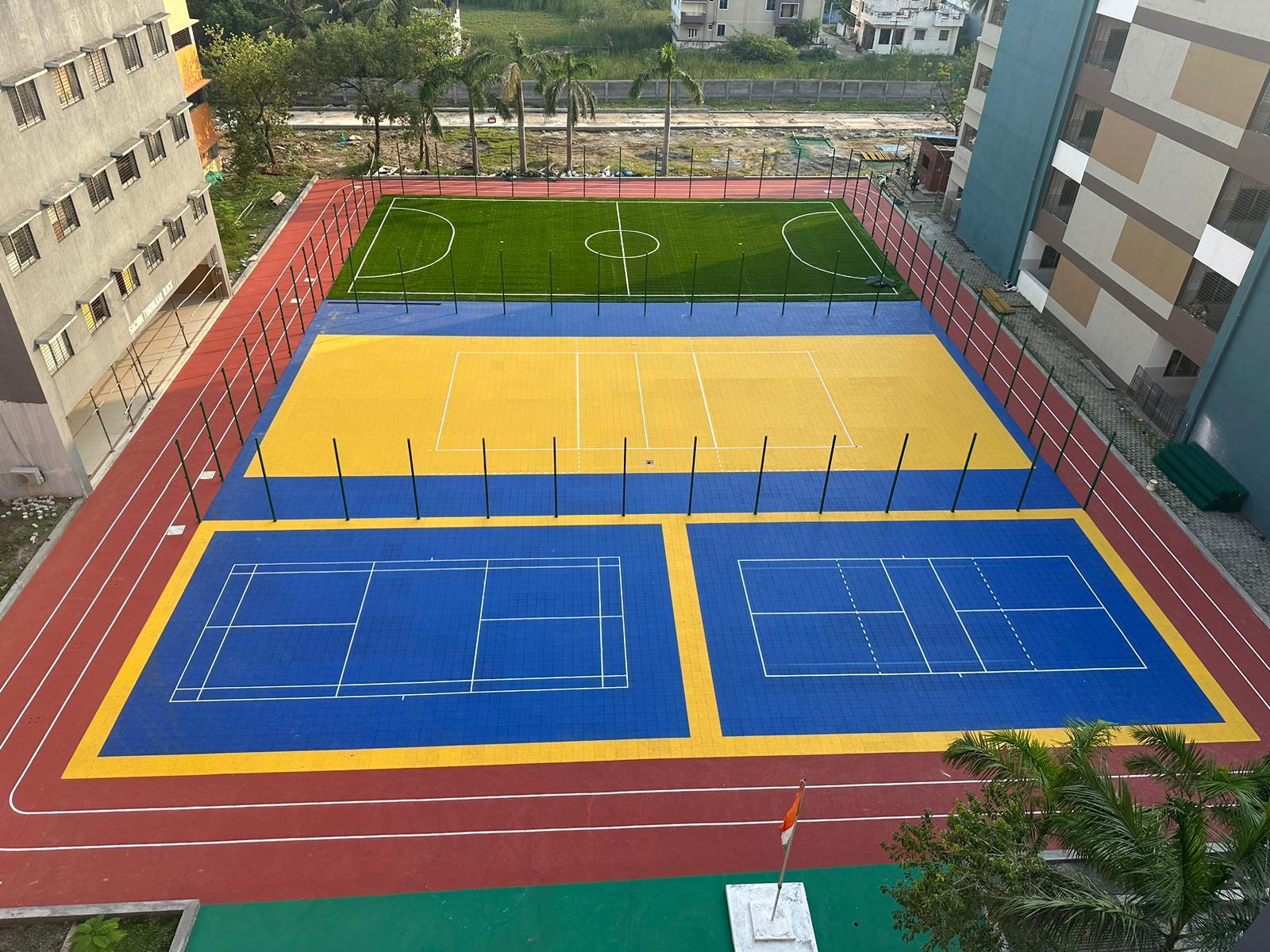
The most operationally significant reason to choose Dayal Infra for a PEB sports hall rather than a generic PEB contractor is that the same company that builds the structure also designs and installs the court flooring, lighting, seating, and sports infrastructure inside it. More than 100,000 square feet of PEB structures, 175,000 square feet of wooden court flooring, 300,000 square feet of PVC courts, 70,000 square feet of running track, and 500 tons of structural steel have all been delivered through the same integrated team.
When the structural contractor and the court flooring specialist are the same organisation, the slab specification is designed with the flooring installation in mind, the structural height is determined with court clearance requirements accounted for from the start, and handover from structure to fit-out happens without the coordination gaps that delay projects when multiple contractors are involved.
For facility owners who have experienced the frustration of a PEB contractor handing over a shell that isn’t compatible with the court installation contractor’s sub-base requirements, or a flooring company discovering that the roof height doesn’t meet BWF minimum standards after the structure is complete, the Dayal Infra integrated approach eliminates those failure modes entirely.