BWF Court Lighting and Flooring Standards Explained
If you have ever played on a court where the lighting was too dim or the floor felt too hard, you already know how much these two things affect the game. A shuttlecock travelling at over 300 km/h needs a player who can see it clearly, track it instantly, and land safely after every jump. That requires both the right light and the right floor working together.
The Badminton World Federation sets very specific standards for both. These are not guidelines that can be loosely interpreted. For any court hosting an official competition, there are requirements.
Why BWF Standards Exist
The reason BWF sets these standards is simple: fairness. Every player at every venue should face the same court conditions. A player training in Chennai should step onto a court with the same quality of light and the same floor response as one training in London or Jakarta.
When lighting and flooring standards are met consistently, the game is decided by skill and not by the environment. Dayal Sports builds every court with this principle at the core, delivering surfaces that meet the same benchmarks used at international competitions.
Lux Levels by Play Category
Lux is the unit used to measure how much light falls on a surface per square metre. The higher the lux level, the brighter the court. BWF specifies different lux requirements depending on the level of play:
- Recreational use and school training: 200 to 500 lux
- Community and club-level matches: 500 to 750 lux
- Professional matches (not televised): 750 to 1000 lux
- Televised international competition: 1000 to 2000 lux
The minimum recommended lighting level for international standard facilities is 1000 lux to provide even light over the entire court area.
No Bright Spots, No Dark Corners
A court that is bright in the centre but dim at the edges creates an unfair playing environment. BWF standards require a uniformity ratio of at least 0.7, meaning the dimmest part of the court must be no less than 70% as bright as the brightest part.
For professional facilities, the uniformity ratio needs to be higher than 0.8 to guarantee that players have consistent visibility throughout the court. This is why professional courts use multiple carefully positioned LED fixtures rather than a few powerful central lights.
Shadows and uneven lighting cause players to misjudge the shuttlecock’s position, especially during high-lift shots where the shuttle moves against a ceiling background. Uniform lighting removes that problem entirely.
Glare Control Is Non-Negotiable
Imagine looking up to track a shuttle during a jump smash and being blinded by a light directly in your line of sight. That is a safety hazard, not just a comfort issue. BWF standards require a Unified Glare Rating or UGR of less than 19 to prevent discomfort for players and referees, particularly during high-speed gameplay.
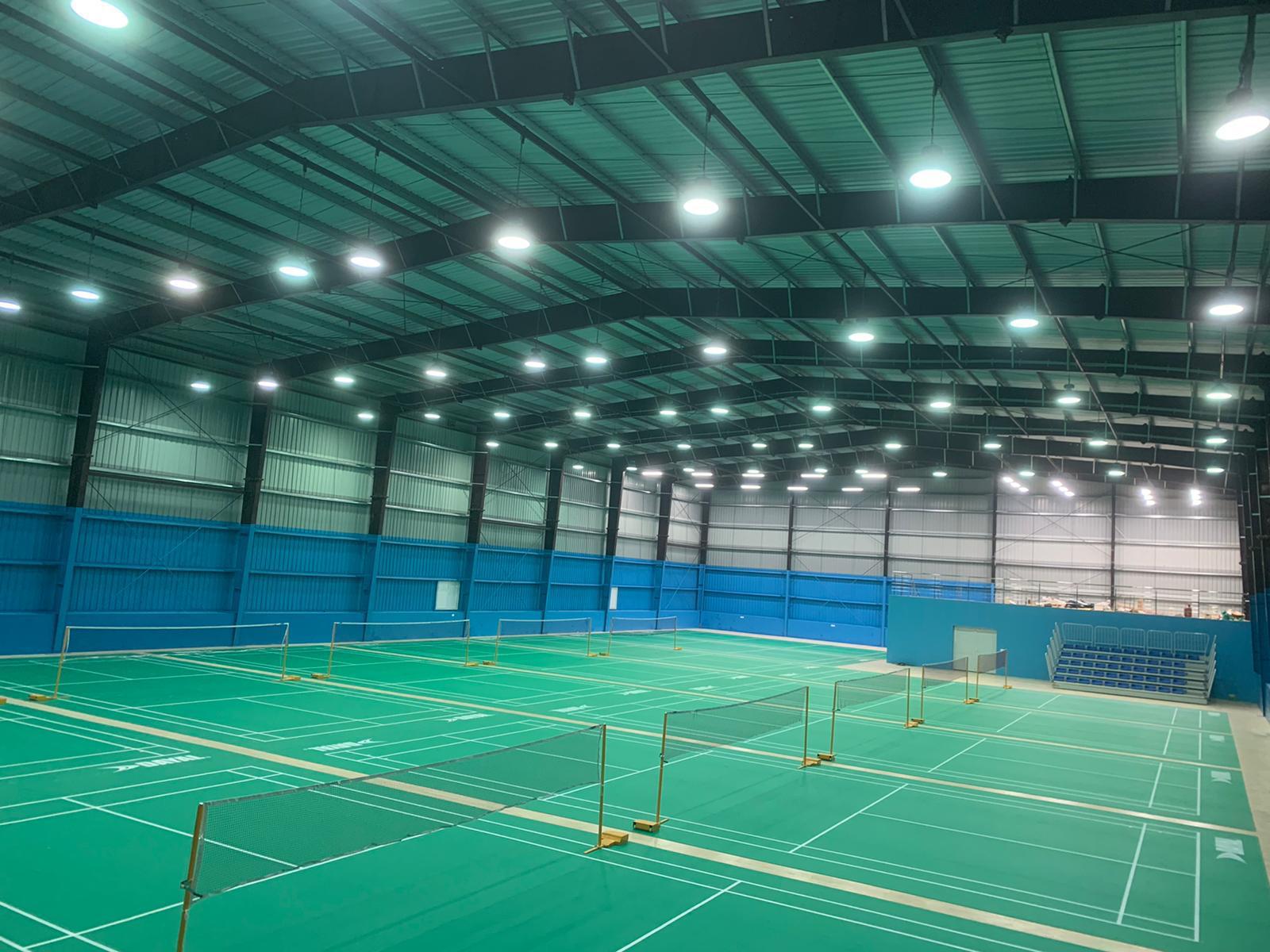
Anti-glare lighting is not optional on a properly set-up badminton court. Lights must be positioned 6 to 9 metres above the floor so they illuminate the court without shining directly into players’ eyes when they look upward.
Vertical Illumination Matters Too
Most people think about lighting in terms of how bright the floor is. But a shuttlecock does not travel along the floor. It moves up, down, and across, sometimes reaching heights close to the ceiling. This is why vertical illumination is just as important as horizontal brightness.
BWF standards and the ASLA require vertical illumination of at least 75% of the horizontal lighting level. For club facilities, 500 lux of vertical illumination is required. For professional events, that goes up to a minimum of 1000 lux vertically. Without adequate vertical light, players lose track of the shuttle against the ceiling background, particularly during defensive lobs and high clears.
Why LED Is Now the Standard
Traditional fluorescent and metal halide lights are no longer adequate for professional badminton courts. LED lighting has replaced them as the standard because:
- It delivers even illumination across the full playing field
- It switches on instantly without warm-up delays
- It uses up to 60% less energy than conventional lamps
- It has a longer lifespan, reducing replacement costs
- It maintains flicker rates below 5% at 100Hz, critical for both player comfort and broadcast quality
For televised matches, flicker-free lighting is essential. High-speed cameras used in broadcasts can pick up flicker that human eyes cannot detect, resulting in poor-quality footage. LED systems eliminate this problem. Explore how Dayal Sports delivers complete court infrastructure, including surfaces optimised for LED lighting systems.
How Lighting and Flooring Work Together
One detail that is easy to overlook is how the floor surface interacts with the lighting above it. A shiny or reflective floor creates glare when light hits it, which affects players just as much as a poorly positioned fixture overhead. BWF certified floors use matte textures that are specifically optimised for 500 to 750 lux lighting systems, reducing reflection and creating a playing environment that is easier on the eyes.
This is why choosing a flooring supplier who understands the full court environment matters. Dayal Sports designs surfaces that perform well both physically and visually under the lighting conditions of a properly set-up badminton hall.
What Dayal Sports Delivers
Dayal Sports was founded by Dr. Yuva Dayalan, a former International Badminton Player and Yoga Champion, with one goal: to give every athlete a surface and environment that matches their ambition.
Every Dayal flooring installation is professionally tested by national sports quality supervision and inspection centres across:
- Shock absorption levels
- Surface friction and slip resistance
- Ball rebound uniformity
- Fire resistance
- Indoor air quality
Research, design, production, construction, and installation all happen under one roof. For schools, academies, clubs, and professional arenas planning a badminton court, Dayal Sports offers free site assessments and expert recommendations on both flooring and full court infrastructure.
For more product details, visit our complete badminton court flooring range at dayalssports.com
For enquiries and contact details, visit dayalssports.in